Odd Shapes, Square Prices: The Quiet Value of Britain’s Crescent and Oval Addresses
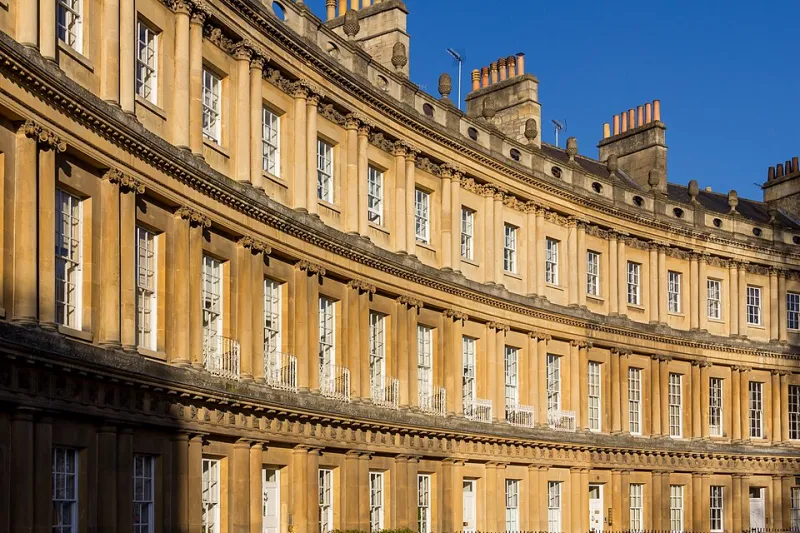
Photo: Photograph by Mike Peel (www.mikepeel.net)., CC BY-SA 4.0, via Wikimedia Commons
Britain’s property language is full of squares that are not square. A crescent curves away from the grid. An oval wraps a garden in a loop. A triangle forces three fronts to meet. Even the word square is often a development type rather than a mathematical fact, a shorthand for a set-piece address with a shared garden and a certain social ambition.
In 2026, as prime city markets reward difference as much as convention, geometry has become part of the pitch. The question for buyers is not whether an odd shape is better or worse than a square. It is how the shape changes light, outlook, landscaping, service charges and the pool of future buyers.
The name is not the geometry
Some of Britain’s best-known set-piece addresses are nowhere near square. The Royal Crescent in Bath is a sweeping arc of Georgian houses. Park Crescent in London frames the edge of Regent’s Park with a curve rather than a rectangle. Adelaide Crescent in Hove and Royal York Crescent in Bristol carry the crescent name with pride. Bath’s Circus is circular, a ring of terraces around a central garden. Many addresses marketed as squares are really oblongs, lozenges or irregular enclaves shaped by old boundaries and road patterns.
The lesson is simple: read the plan, not just the name. A square implies four sides and a clear relationship between façade and garden. A crescent implies a longer shared frontage and a different pattern of views. An oval implies enclosure and a loop. A triangle implies compromise, but sometimes a very distinguished one.
Why a curve can be worth more than a corner
Geometry affects sunlight. A south-facing curve can capture light from a wider arc than a straight terrace, while a north-facing arc may never quite lose its chill. It affects outlook: a convex façade gives diagonal views along the terrace, while a concave one draws the eye inward to the garden. It affects privacy: corners may be overlooked from two directions, while the middle of a long curve may feel surprisingly secluded.
Landscaping follows the same logic. A rectangular garden is easy to divide into lawns, paths and beds. A crescent garden may demand a more theatrical layout, with planting designed to be seen from many angles. An oval garden can create a strong sense of enclosure, but the best positions depend on which segment of the ring faces the sun. An irregular site may produce awkward strips of land that become either maintenance liabilities or unexpectedly lovely pockets.
The crescent: borrowed landscape, shared façade
The crescent is the most familiar of the non-squares, and arguably the most effective. A long curved terrace presents a unified front to the street or park, giving individual houses the benefit of a collective architectural gesture. The shared garden, where one exists, is often arranged in front of the curve rather than at its centre, so that the terrace borrows the landscape beyond.
That borrowed landscape can support a premium. A crescent overlooking a park, an esplanade or a protected green has an outlook that a conventional square cannot easily replicate. The trade-off is a long shared frontage: repairs to roofs, railings and façades require coordination, and the service charge may reflect the complexity of maintaining a single architectural composition rather than a collection of separate houses.
The oval and the circus: enclosure without a grid
An oval or circular set-piece creates one of the strongest forms of urban enclosure. The garden sits at the centre; the terraces wrap around it; the street becomes a loop rather than a through route. Bath’s Circus shows how powerful the form can be, with its curved terraces creating a sense of arrival that a rectangular square rarely matches.
For buyers, the oval demands a careful reading of orientation. Not every segment of the ring is equal. The south-facing arc may command the best light; the north-facing arc may compensate with views or architectural detail. The central garden may be shared by all, but access, keys and maintenance obligations can vary. An oval can feel like a private world, but it can also be a complex one to administer.
The triangle and the irregular enclave: compromise or character?
Triangular and irregular sites often arise from road junctions, historic boundaries or estate planning that prioritised a grand gesture over a neat grid. They can produce wedge-shaped plots, chamfered corners, unexpected garden widths and interiors that need clever planning. In the wrong hands, that is merely awkward. In the right hands, it is character.
The premium here is rarely automatic. A triangle may have less usable garden, more boundary wall and a more convoluted service-charge apportionment. But it may also have rarity, a distinctive address and a plan that cannot be replicated by a volume housebuilder. The buyer who wants an odd shape is often buying a story as much as a floor plan.
How geometry reaches the service charge
Shape is not only an aesthetic matter. It influences the cost of maintaining communal gardens, railings, retaining walls, drainage, lighting and shared access. A crescent with a long curved frontage may need more scaffold for façade repairs. An irregular enclave may have more boundaries to maintain and more complex insurance arrangements. An oval may require specialist gardening to keep the central garden looking good from every angle.
Buyers should ask for the service-charge budget and a history of special levies, not just the current annual figure. They should also ask how apportionments are calculated and whether the geometry of the site makes some units more expensive to maintain than others. A beautiful curve can be a bargain or a burden, depending on the paperwork behind it.
Resale: the buyer who wants the odd shape
Odd shapes tend to narrow the pool of buyers but deepen it among those who care. A conventional square is familiar and liquid. A crescent, oval or triangle is a landmark, and landmarks photograph well. The resale premium, where it exists, comes from scarcity, outlook and the sense of an address that is not interchangeable with the next street.
The risk is that awkwardness without quality becomes merely awkward. A triangular site with poor light, a cramped plan and a high service charge will not be rescued by its shape. But a well-managed crescent with a protected garden, a strong façade and a good orientation can outperform a plainer square nearby.
At Eleventh Square, the set-piece square remains the benchmark for prime city living. Yet the non-square squares deserve attention. They remind buyers that geometry is not a detail. It shapes the morning light, the evening view, the cost of the communal garden and the story a property tells when it comes to market. The address may say square, but the shape often tells the truer tale.