The Digits on the Door: How Address Mechanics Quietly Shape Life on a Prime Square
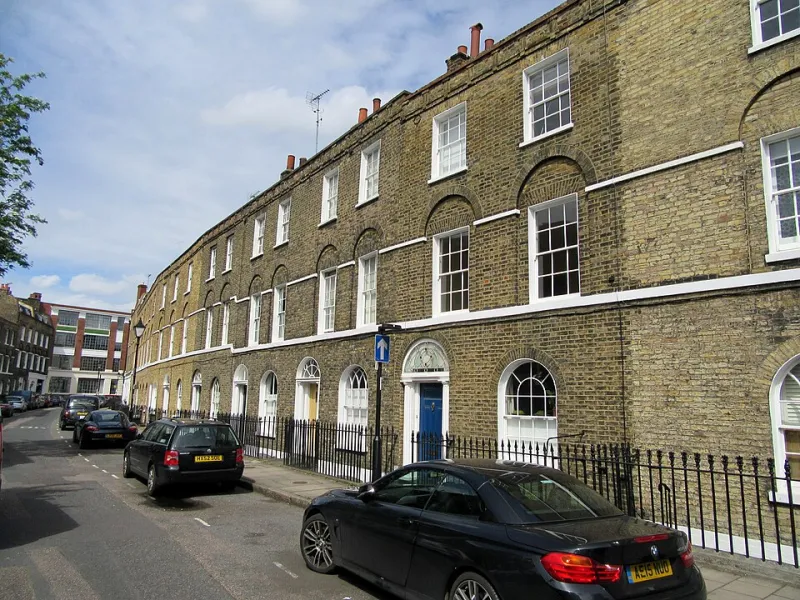
Photo: John H Darch , CC BY-SA 2.0, via Wikimedia Commons
Walk the perimeter of any prime square in Britain and the houses will appear, at first glance, to be a single architectural thought. Look closer and the seam lines emerge: a terrace that changes from even to odd numbering halfway along, a postcode that shifts between one end of a colonnade and the other, a rear lane that serves four properties and ignores the rest. These are administrative facts rather than architectural ones, and they are routinely overlooked during viewings. In 2026, with transaction costs high and buyers more forensic than ever, they deserve a place on the checklist.
The Arithmetic of Prestige
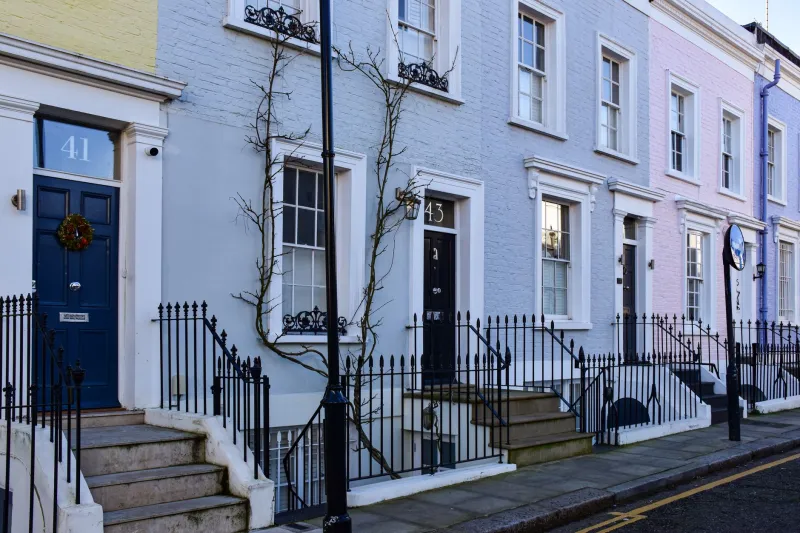
Numbering on British squares is seldom elegant. Some terraces run consecutively around the square; others use the older convention of odds on one side, evens on the other, with a resulting asymmetry that surprises buyers arriving from London streets where the rhythm is familiar. There are squares where number 1 sits beside number 40 because the terrace was extended in phases, and squares where a single address was later subdivided, giving rise to 12, 12A and 12A½.
Why does this matter commercially? Because numbering shapes recall. A low number on the principal, garden-facing terrace carries a certain cachet; a high number on a side return does not, even where the internal accommodation is identical. Estate agents know this and price accordingly. Buyers should test the assumption rather than inherit it. Compare recent sales of comparable houses at different points in the sequence and ask whether the premium attached to a particular number is architectural, or merely ordinal.
There is also the question of naming. A house known by name rather than number can feel more distinguished, but it can complicate searches, insurance and conveyancing where the name has never been formally registered with the local authority. If the property is marketed as 'The Old Rectory' but the Land Registry title refers to 14 Square Terrace, ensure the two are reconciled before exchange.
When the Postcode Changes Mid-Terrace
Postcode boundaries are drawn for the convenience of postal sorting, not for the coherence of a square. It is entirely possible for the eastern arm of a garden square to fall within one postcode district and the western arm another, with knock-on effects for insurance premiums, council tax banding comparisons and, occasionally, school catchment conventions. Buyers who have set their hearts on a specific postcode should confirm the precise boundary rather than assume the whole square shares it.
This is not merely a matter of vanity. Lending valuations frequently draw on comparable evidence gathered by postcode, and a property on the 'wrong' side of an invisible line may be compared with a weaker set of sales. Conversely, an address at the edge of a prestigious postcode can benefit from a halo it has not strictly earned. Either way, the buyer should know which side of the line they are on, and price the property on its own merits rather than its alphanumeric label.
Corner Plots and the Two-Frontage Question
Corner houses on squares occupy an ambiguous position. They may carry two addresses, one on the square and one on the adjoining street, and the choice of which to use is sometimes a matter of historical accident rather than deliberate preference. The practical consequences are real: deliveries may arrive at the wrong door, visitors may approach from the less impressive elevation, and the property's marketing identity may shift depending on which address the agent favours.
There is also a legal dimension. A corner plot with dual frontage may carry obligations toward two sets of frontagers, or rights of access across a strip of land that belongs to neither. Solicitors should be asked specifically which address appears on the title, which appears on the council tax register, and whether the property has ever been known by another number. Discrepancies are usually harmless, but they are considerably easier to resolve before completion than afterwards.
The Service Yard Behind the Number
Front doors on prime squares are for arrival; the working life of the house runs through the back. Buyers should establish precisely which rear access serves the property, who else uses it, and on what terms. A shared service road that serves six houses is a different proposition from a private mews yard, and the maintenance liability differs accordingly. Ask to see the apportionment schedule, not merely the existence of a management company.
Where a square has a service charge, the rear access arrangements are often buried in the same documentation as the garden contribution. Read both. It is not unusual for the cost of resurfacing a rear lane to be shared among frontagers who rarely use it, and for the obligation to be enforceable.
Parcels, Pallets and the Everyday
Delivery logistics have become a genuine quality-of-life issue on British squares, particularly where parking is restricted and vehicle access is limited to a single entrance. A property whose only accessible door opens onto a pedestrianised side of the square will receive parcels differently from one with a rear yard accessible from a lane. For residents who work from home, or who order regularly, this is not a trivial distinction.
It is worth asking, during a viewing, where couriers actually leave things, whether there is a concierge or porter, and whether neighbouring properties have adopted a shared parcel arrangement. On well-run squares these small systems are often informal but effective. On poorly run ones, they are a source of quiet daily friction.
What to Check Before You Commit
Before exchange, confirm the following: the address as recorded at HM Land Registry; the address used by the local authority for council tax; the postcode boundary and whether it matches the marketing particulars; the numbering convention and whether the property has ever been known by another number or name; the rear access arrangements and their apportionment; and the practical realities of delivery and parking. None of these will appear in a brochure, and few will be raised unprompted by an agent. They are, nonetheless, part of what you are buying.
A prime square is as much an administrative artefact as an architectural one. The house is handsome; the address is the machinery that makes it function. Buyers who understand both tend to negotiate better and live more comfortably — and in the current market, that combination is worth rather more than a low number on the door.