The Compass Is Not the Answer: Auditing Daylight on Britain's Prime Squares
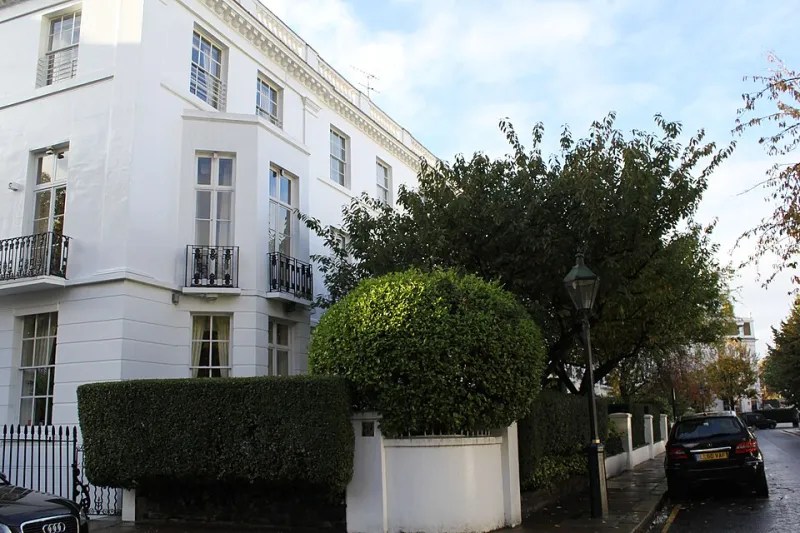
Photo: Edwardx, CC BY-SA 3.0, via Wikimedia Commons
Every square has a received wisdom about which side is best. It is usually delivered in four words — south-facing, quiet, mature trees — and it is usually half right. On the enclosed geometry of a British square, daylight behaves less like a compass reading and more like a calculation, in which the orientation of the terrace is only the first of several inputs. Buyers and renters who treat the compass as the answer tend to pay for a label rather than for light.
Why orientation misleads inside a square
A terrace on an open street answers to the sun. A terrace on a square answers to the square. The width of the enclosure, the height of the opposite range, the depth of the front gardens and the position of the building within its own terrace all intervene between the sun and the sash window.
A north side is not, in practice, a permanently shaded side. In summer, a north-facing elevation on a square with a generous garden receives direct light at the beginning and end of the day, and good reflected light throughout. A south side, by contrast, may lose its strongest sun to a row of mature planes by mid-afternoon, or find its lower floors screened by the mansard and dormer additions that have accumulated on the range opposite over a century.
The obvious case — a south-west corner house with an open aspect and a clear skyline — is real, and it is priced accordingly. It is simply rarer than the particulars suggest.
The four determinants of light
Once past orientation, four variables do most of the work.
Canopy. Deciduous trees are an asset in July and an obstruction in October. A square with heavy lime or plane planting may be dark at ground level for six months and bright for six. Evergreens, by contrast, deliver a consistent penalty. The relevant question is not how many trees there are, but which of them shed their leaves and where they stand relative to your principal windows.
Height of the opposite range. A four-storey terrace facing a three-storey terrace of greater setback will admit materially more light to its lower floors than the reverse. Comparative height, not absolute height, governs the shadow line.
Terrace depth and window area. A deep, narrow-plan house with small sash windows on a bright aspect can be gloomier in its middle rooms than a shallower house on a duller one. Ceiling height, window-to-wall ratio and the presence of a lightwell or rear extension all matter.
Neighbouring rooflines. Rear extensions, side returns, roof terraces and the glazed rear additions that have proliferated on prime squares all cast shadows that did not exist when the square was laid out. They are also the most likely of the four to change, which makes them worth understanding before, rather than after, exchange.
A three-visit method
Daylight cannot be judged in a single viewing, and it certainly cannot be judged in the twenty minutes allocated to a second appointment. A workable audit takes three visits.
Visit once in the morning, once around midday and once in the late afternoon. On each occasion, stand at the same three points — the front pavement, the principal reception room window, and the rear of the plan — and record the time, the date and whether the sun is direct, reflected or absent. A phone compass and a sun-position application will give you the solar azimuth for the hour; a simple photograph from a fixed position on each visit will do more for your judgement than any written description.
Then repeat at least one of those visits in winter, ideally between November and February. The winter sun sits low and traverses a short arc, which exposes obstructions that are invisible in June. A house that is bright in May and dark in January is a common outcome on squares where a single building on the southern range is one storey taller than its neighbours.
Room by room, not house by house
Light is a room-level attribute, and the audit should be conducted room by room. The questions differ by function.
- Reception rooms need direct light at the hours they are used. A west-facing drawing room is magnificent in the evening and cold in the morning; for a household that works from home, that may be the wrong half of the day.
- Kitchens and basements are the usual casualties. Lower-ground floors on squares are frequently excavated, and an excavated lightwell with a glazed roof performs very differently from an original, deeper one. Ask when the well was formed and whether the glazing is on the drawings.
- Principal bedrooms tolerate north light better than most buyers assume, and a north aspect often brings cooler summer nights.
- Studies and home offices benefit from indirect, stable light. Direct southern sun on a screen from eleven to three is a liability in August.
The purpose of the exercise is to match light to hours of use. A property that is brilliant at midday and empty at midday has not delivered the premium its vendor is charging.
Pricing the gap
Where a bright mid-terrace and a shadowed corner house sit on the same square, the market's instinct is to favour the mid-terrace and to apply a general discount to the corner. That instinct deserves testing, because a corner typically offers two aspects, a wider frontage and, often, a greater garden length. It may lose on peak midday sun and win comprehensively at either end of the day.
The defensible approach is to establish the price per square foot of comparables on the same square, then adjust deliberately rather than impressionistically: a defined percentage for aspect, a further adjustment for floor level, and a separate allowance for the condition of windows and any interior gloom that could be remedied by decoration. Surveyors and valuers rarely quantify a daylight premium directly; they reflect it in comparable selection, which is precisely why a buyer should arrive at the negotiation with their own recorded evidence.
Sellers should expect the same scrutiny in reverse. A documented light record — times, dates, photographs — is a more persuasive sales document than the word 'bright' in a brochure, and it survives the scepticism of a second viewing.
Before you commit
Put four questions to the agent in writing: which way the principal elevation faces; the height of the range opposite relative to the subject property; whether any planning consents exist on the adjoining rooflines; and whether the freeholder or garden committee has any plans affecting the trees. The answers will not tell you everything, but the reluctance to answer will tell you a good deal.
Daylight is the one attribute of a prime square property that cannot be refurbished, extended or decorated away. It is worth arriving early with a compass, a camera and an hour to spare.