The Side-Window Advantage: How Corner Houses Really Trade on Britain's Prime Squares
A corner house on a prime garden square carries an obvious appeal. It presents two elevations rather than one, often brings more windows and a side entrance, and can offer a route to the garden or to the rear without passing through the main hall. Yet the market does not treat every corner alike. Across Britain's prime squares, corner plots can trade at a modest discount to comparable houses mid-terrace, at a clear premium, or at no discernible difference at all. The reason is that 'corner' is not a single attribute but a bundle of rights, exposures and obligations.
The corner is not one product
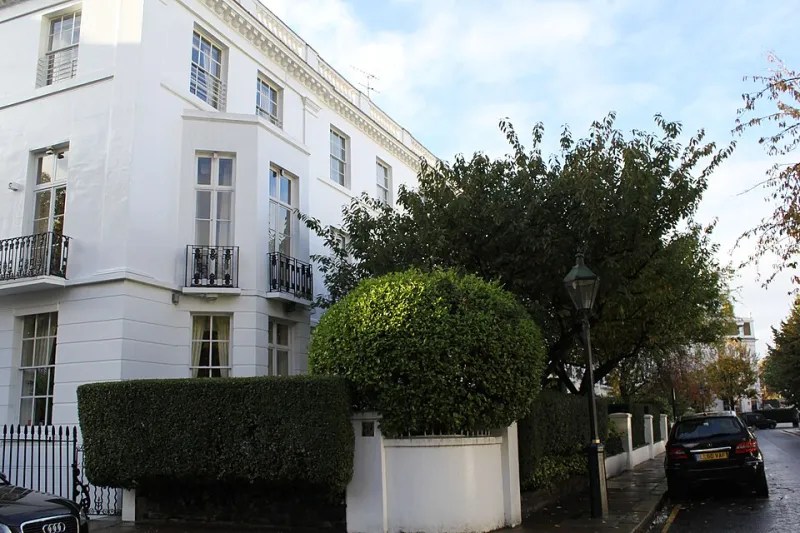
The first task is to establish which corner is being sold. An end-of-terrace house on the quiet garden side of a square is a different proposition from a house at a junction with a busy radial road. A corner that turns into a service lane may offer useful access but also bring bins, deliveries and early-morning noise. A corner on a pedestrian-only edge may have two garden-facing elevations and very little passing traffic. The geometry matters, but so does the immediate context.
On some squares the corner house is the widest on the terrace; on others it is constrained by a return wall, a later extension or a boundary that cuts across the original plan. Buyers should look at the title plan and the lease plan before accepting an agent's description of a corner plot. The phrase is often used loosely.
How the pricing actually works
There is no reliable national rule for corner pricing. Turnover on prime squares is low, comparable evidence is thin, and valuers are often working from a handful of transactions. In practice, a quiet discount tends to appear where the corner brings more exposure than advantage: two façades to maintain, side windows that overlook a busy pavement, a side door that is awkward to use, or a garden boundary that is shared with a neighbouring estate.
A premium is more likely where the corner delivers something genuinely scarce: a private side entrance, a gate into the garden, two quiet elevations, or a plan that allows a study or kitchen to sit away from the main reception rooms. Even then, the premium may be absorbed into the wider value of the address. On trophy squares, the corner is often priced as part of the square's mystique rather than as a measurable improvement.
In 2026, buyers are also more alert to running costs and nuisance than they were in a softer market. A corner that looks charming in an estate agent's photograph may lose its appeal when the side elevation faces a bus stop, a school run or a late-night delivery route. That does not make it a bad house; it makes it a different house, and the price should reflect the difference.
Light, windows and exposure
The extra windows are the most visible benefit. A corner can bring light into rooms that would otherwise be internal, and a side window can make a narrow plan feel more generous. But windows are also points of exposure. A ground-floor side window onto a pavement may need planting, shutters or a higher sill. Upper windows may be overlooked by a neighbouring return. Some side windows are original; others were inserted later and may not have the benefit of a clear right to light.
The orientation of the two elevations matters as much as their number. A south-facing garden front combined with a west-facing side return can be excellent; two north-facing elevations can leave the corner feeling darker than a mid-terrace house with a better aspect. Buyers should visit at different times of day and in different seasons, and should check whether mature trees, boundary walls or later extensions have narrowed the light that the windows were designed to capture.
Access, servicing and the side entrance
Side access is one of the corner's most practical assets. It can keep bins, bicycles and garden equipment out of the main house, and it can provide a route to a rear garden without crossing a reception room. In leasehold squares, however, the side path may be common property, subject to a right of way, or shared with a neighbour. The gate may be maintained by the estate, and the key may not be included in the tenancy or the sale.
Refuse collection is another corner issue. A house at the turn of the square may be convenient for the collection crew, which can mean early noise and bins left in view. Delivery drivers and visitors may also use the corner as a turning point. These are small things individually, but they shape daily life. For renters, the tenancy should be checked for access to the side entrance and the garden, not just the front door.
Maintenance, consent and the lease
Two elevations mean more external maintenance. Repointing, painting, roof repairs, railings and boundary walls all have to be considered. On a listed building or in a conservation area, changes to windows, doors, railings and basements may require consent. A corner house may also carry a greater share of repairing liability if the lease or estate covenants allocate responsibility by frontage or by external wall.
The garden committee or estate management company matters here. Rules on planting, external colours, window boxes, satellite dishes and access to the garden can affect the corner more than a mid-terrace house, because the corner is more visible. Buyers should read the lease, the estate covenants and the latest service-charge accounts before assuming that the corner's extra frontage is cost-free.
When the discount disappears
The discount tends to disappear when the corner is both quiet and useful. A house with two garden-facing elevations, a private side gate, mature planting and no through traffic can be the best seat on the square. It may also be priced accordingly. The same is true on small squares where every house is visible and the corner is part of the square's architectural set piece.
At the other end of the scale, a corner on a busy junction may be priced at a discount that looks attractive until the buyer has lived through a winter of traffic noise and dirty windows. The discount is not a bargain if it simply compensates for a liability the buyer has not costed.
What to check before you commit
Start with the plans. Confirm which boundaries are included, which are shared, and where the side access runs. Read the lease and estate covenants for rights of way, gates, keys and maintenance obligations. Visit at rush hour, on bin day and on a weekend evening. Look at the side windows from the pavement and from inside, and consider what planting or shutters would cost. Check the planning history for extensions, basement works and window alterations, and take advice on listed building consent where relevant.
Finally, compare the corner with a mid-terrace house on the same square on a like-for-like basis. The corner may offer more light, more access and more presence. It may also offer more exposure, more maintenance and more rules. The right price is the one that reflects both sides of the ledger. In 2026, that is a more disciplined test than the old assumption that the corner is always the best seat in the square.