The Vertical Estate: Airspace, Rooftops and Value Above a Prime Square Address
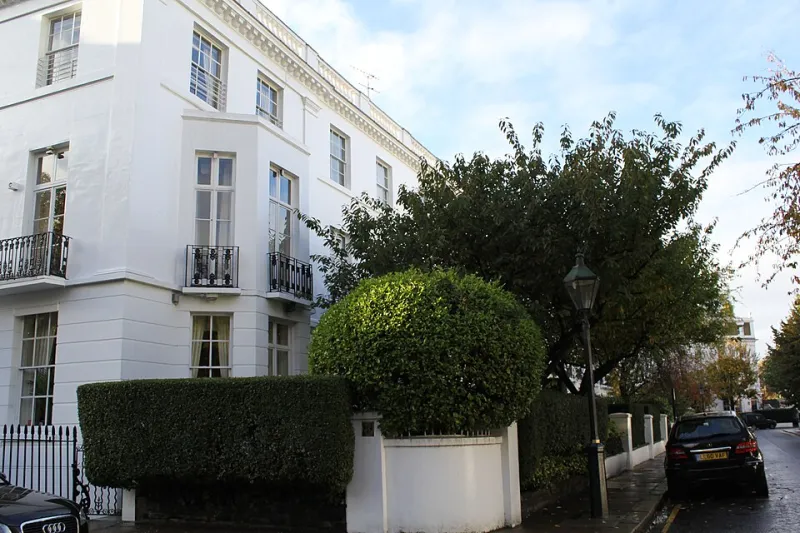
Photo: Edwardx, CC BY-SA 3.0, via Wikimedia Commons
Prime square living is usually discussed at eye level: the proportions of a drawing room, the width of a pavement, the view across communal gardens. Yet some of the most consequential rights in a Georgian terrace or a Victorian mansion block sit considerably higher. The airspace above a roof can be let to telecoms operators, burdened by ventilation plant, earmarked for a roof terrace or quietly reserved by a freeholder. For buyers and renters examining a square address in 2026, the vertical estate deserves the same scrutiny as the horizontal one.
What the ceiling line actually marks
In England and Wales, the starting principle is that a freeholder owns the land and the airspace above it to a reasonable height, subject to statute, covenant and any separate registration. That broad principle becomes more complicated in a building divided into flats. A lease will normally define the demised premises by reference to floor levels, internal surfaces and sometimes the structure itself. The roof, the chimney stacks and the airspace above them may remain with the landlord or be retained under a separate title.
HM Land Registry can register airspace as a separate legal estate where it is precisely defined by a plan and satisfies registration requirements. This is not an everyday arrangement on residential squares, but it does occur where rooftop development, telecoms equipment or plant has been carved out. A title plan may therefore show a dotted line above the building rather than simply around it. Buyers should ask their solicitor to confirm whether the roof and airspace are included in the freehold or lease, retained by another party, or subject to rights granted to a third party.
Scotland has its own regime for tenement and common property, and the position in Edinburgh or Glasgow new-build squares will not mirror England and Wales. The practical lesson is the same: do not assume that the top of the building is the top of the ownership.
Reading the lease plan and the covenants
A lease plan is not merely a diagram for locating the front door. On a prime square, it can reveal whether the roof is demised, whether the airspace is excluded, and whether the tenant has rights to install equipment. Clauses dealing with alterations, aerials, satellite dishes and external appearance matter more than many buyers expect. A covenant requiring landlord consent for any addition to the roof can frustrate a solar array or air-conditioning unit, even where planning permission would otherwise be granted.
Freehold houses on a square bring a different set of questions. Restrictive covenants may limit height, prohibit additional storeys or control the placement of roof lights and flues. Some estates retain rights over the roofscape to preserve the architectural character of the square. These are not merely historical curiosities. They can determine whether a loft conversion, roof terrace or plant enclosure is deliverable, and they can affect resale value.
Telecoms, plant and the income above
Rooftop telecoms leases are perhaps the best-known form of airspace value. An operator may pay an annual rent for masts, antennas and equipment cabins, often with rights of access for maintenance. The Electronic Communications Code gives operators certain rights and can affect how agreements are renewed or terminated. A telecoms lease can be an attractive income stream, but it is not a risk-free one. The lease term, review provisions, break rights, sharing clauses and the operator's repairing obligations all influence what a buyer should pay for it.
Ventilation plant presents the opposite case. A rooftop unit serving a restaurant, a commercial unit or the building's own services may generate no income at all, but it can create obligations, noise and access requirements. The lease or service charge budget should show who maintains the plant, who pays for its replacement and whether the landlord has rights to enter the demised premises. On a square with mixed commercial and residential use, these details can matter as much as the specification of the kitchen.
Extensions, terraces and solar arrays
Permitted development rights do not override private covenants or lease terms. A buyer contemplating a roof extension should establish the planning position, the party wall implications and the landlord's consent requirements before exchange. The same applies to a roof terrace, which may require structural strengthening, fire safety assessment and consent from the freeholder or management company. On a listed building or within a conservation area, the additional controls are well known, but the private-law consents are often the ones that stall a project.
Solar arrays are increasingly part of the calculation. A roof lease or licence may be needed where the panels are installed by a third-party provider, and the building's insurance, structural capacity and export arrangement all require review. The income from exported electricity is rarely transformative on a single house, but the right to install, access and remove equipment can affect the building's future flexibility.
Placing a value on the vertical estate
Existing airspace income is usually valued by capitalising the net rent at a risk-adjusted yield, with adjustments for lease length, counterparty strength and the cost of reinstatement. Potential development value is more speculative. It should be assessed net of legal costs, construction costs, consent risk and any loss of amenity to lower floors. A surveyor should be asked to separate the value of the roof and airspace from the value of the living accommodation, so that the buyer does not pay twice for the same opportunity.
A due-diligence sequence for buyers
- Obtain the title register and title plan, and ask whether airspace is separately registered.
- Read the lease plan and any roof or airspace exclusion clauses.
- Identify telecoms, plant, aerials and solar equipment, and obtain the associated agreements.
- Check covenants, landlord consent requirements and estate management rules.
- Review planning history and any extant permissions for rooftop development.
- Confirm insurance, access and repairing obligations for anything above the ceiling line.
At Eleventh Square, the guiding principle is that a prime square address is a bundle of rights, not simply a set of rooms. The sky above the parapet may be empty, monetised or constrained. Establishing which, before contracts are exchanged, is the difference between buying a home and buying an unresolved vertical estate.